Flagship 01 · ROS 2 · GO2 + Jetson
HELIX: the layer that notices before the robot does
A ROS 2 reliability layer that detects runtime faults, turns raw symptoms into structured FaultEvents, diagnoses the likely cause, and audits every zero-velocity recovery command before it is trusted.
01 The problem
Learned robot policies fail in ways that look normal from the outside. Sensors go stale while still publishing. Recurrent state freezes. Topic rates degrade without dropping to zero. Policy outputs stay numerically plausible long after they stopped meaning anything.
A deployment stack needs a layer that notices the system is becoming untrustworthy before a user or a robot is exposed to the consequence, and that can prove afterwards what it noticed and when.
02 Why existing approaches fall short
Plenty of robotics work ships a trained policy or a navigation stack. Far less ships the operational layer around it: the thing that detects silent failure, separates confirmed behavior from inferred behavior, and refuses to overclaim when the physical intervention path is not wired.
Simulation validation does not establish hardware safety. For an edge robot the reliability layer has to run inside ROS 2, fit a companion computer's budget, survive real topic timing, and leave an audit trail. Most monitoring tooling assumes a datacenter, not a Jetson on a robot.
03 Core insight
Separate sensing from acting, and make the split explicit in the evidence. That decision is what lets HELIX prove faults were detected and recovery commands published, without claiming the robot physically executed a safe hold. When the actuation path turned out to be unsubscribed, the architecture surfaced it as a finding instead of hiding it behind a green dashboard.
04 Architecture
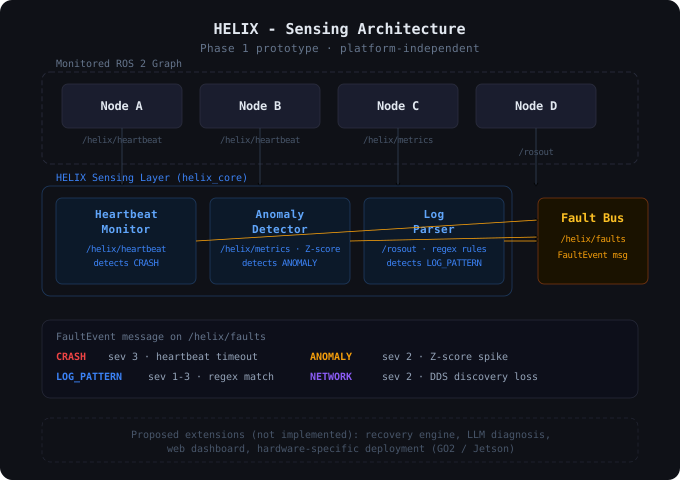
Heartbeat monitoring, topic-rate anomaly detection, and log-pattern parsing feed a diagnosis stage that emits structured FaultEvents. Diagnosis produces recovery hints; a cooldown-aware auditor decides whether an action is permitted, records it, and publishes the zero-velocity command on a dedicated topic.
05 What I built
06 Validation method
07 Results
08 Verified vs pending
Verified on hardware
Not yet proven
09 Limitations
HELIX is strongest as a runtime evidence and control-plane layer. It is not yet proof that the GO2 physically executes a recovery stop. The anomaly detector still needs threshold tuning for natural idle jitter and a dedicated stale-topic path for silent dropouts, and the headline detector numbers come from synthetic anomalies rather than a corpus of confirmed real faults.
10 Next step
Wire a real subscriber to /helix/cmd_vel in a controlled
lab session and demonstrate that an injected fault physically holds the
robot, with the motion path instrumented on both ends. That single
session converts the largest pending row in the ledger into a verified
one.